A Simple Paragraph Framework Teachers Can Use to Improve Student Writing Coherence Fast
When student paragraphs feel scattered, the problem is rarely vocabulary or grammar; it's structure. This guide covers how to introduce it, common mistakes to watch for, and how to adapt it across IELTS, ESL, and academic writing contexts.

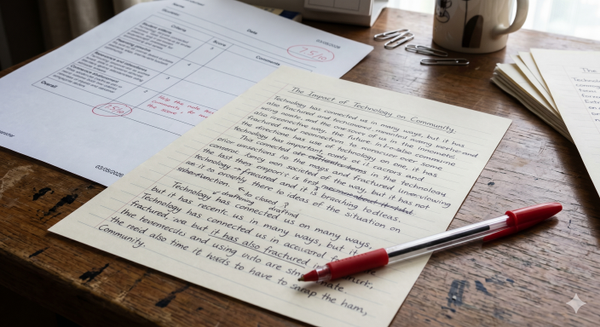
When students write paragraphs that feel scattered, the issue usually isn't vocabulary or grammar—it's structure. They introduce an idea, add an unrelated point, include a disconnected example, and the paragraph drifts. The reader works too hard to follow the logic.
This pattern appears across contexts: IELTS essays, academic writing, professional emails. The PEEL framework (Point, Evidence, Explanation, Link) offers a teachable structure that can produce noticeable improvements quickly.
What Makes Student Paragraphs Incoherent
Three patterns create most coherence problems:
Multiple competing points in one paragraph. A student writes about environmental benefits, then shifts to economic concerns mid-paragraph. Each sentence may be correct, but the paragraph lacks focus.
Evidence without explanation. Students include facts or examples, then move on without showing how they support the main point. The connection may seem obvious to them, but it's not explicit.
Missing or mechanical transitions. Paragraphs end abruptly, or students add formulaic phrases like "In conclusion" without connecting back to the larger argument.
These problems often stem from associative thinking—students add related ideas as they occur. What they need is structure that guides them toward unified paragraphs.
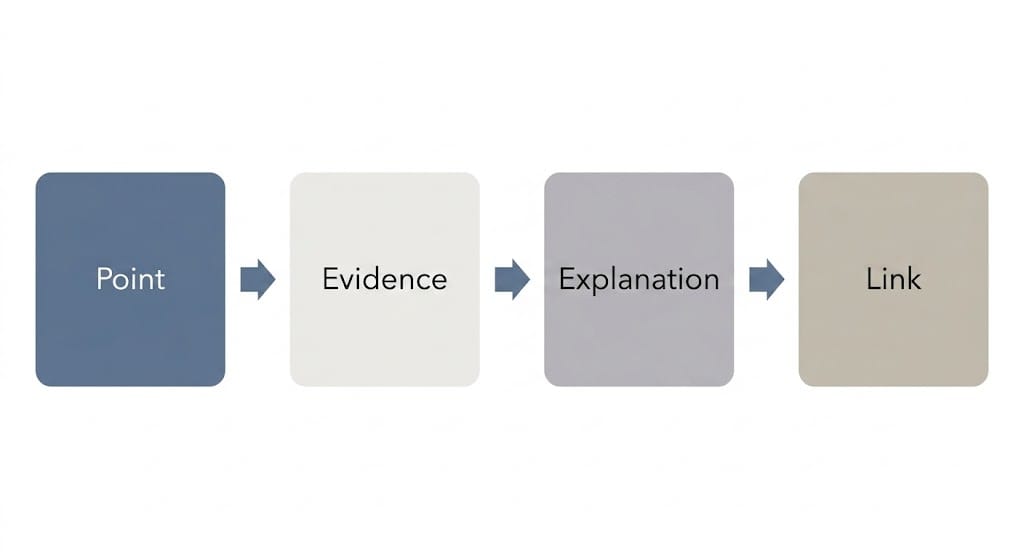
The PEEL Framework: Point, Evidence, Explanation, Link
PEEL provides four concrete steps:
- Point: A clear topic sentence introducing one main idea
- Evidence: Supporting detail—example, fact, scenario, or observation
- Explanation: Analysis showing how the evidence supports the point
- Link: Connection back to the essay's thesis or transition to the next idea
This structure works in test-prep and ESL contexts because it's explicit. Students don't guess what "well-developed" means—they follow four steps.
Point maintains focus. A clear, singular topic sentence makes it harder for paragraphs to drift.
Evidence grounds claims in concrete support rather than assertion.
Explanation addresses where coherence often breaks down. Students learn that including evidence isn't enough—they must show why it matters.
Link connects the paragraph to the larger argument, preventing isolated or disconnected paragraphs.
Teaching PEEL Step by Step
Start by modeling a complete PEEL paragraph with each component labeled. Use simple content so students focus on structure rather than complex ideas.
Deconstruct weak paragraphs together. Show paragraphs missing PEEL components and ask students to identify what's missing. This builds diagnostic skill.
Give students partially completed paragraphs to finish. Provide Point and Evidence; have them write Explanation and Link. This isolates the skill and reduces cognitive load.
Once comfortable with each component, ask students to write full PEEL paragraphs from prompts. Keep topics straightforward initially—the goal is internalizing structure, not complex argumentation.
Using the same prompt across multiple sessions helps students see patterns and makes the structure feel more automatic.
Common Mistakes and How to Fix Them
Multiple points in one paragraph remains frequent. Students write about health benefits, then introduce cost concerns. Ask: "Does every sentence relate directly to the topic sentence?" Extra points usually belong in separate paragraphs.
Unsupported evidence occurs when students include facts without explanation, assuming relevance is obvious. Require an Explanation sentence for every piece of Evidence, even when connections seem clear.
Mechanical or missing links appear when students skip the Link or add generic phrases like "Therefore, this is important." Teach that Links should either connect to the thesis or set up the next paragraph—they have a specific job.
Over-explaining happens when students write multiple sentences analyzing the same evidence. Clarify that Explanation means showing connection, not restating evidence differently.
Adapting PEEL Across Contexts
In IELTS Task 2, PEEL aligns with scoring criteria. Point addresses Task Response with clear positioning. Evidence and Explanation support coherence and cohesion through logical development. Link reinforces the overall argument.
In general ESL writing, PEEL helps students move from list-like paragraphs to developed academic prose—especially for those transitioning from sentence-level accuracy work to paragraph-level organization.
In academic essays, PEEL adapts to include multiple evidence pieces or more complex explanation while maintaining its foundational structure.
For argumentative writing, Explanation becomes the most critical step. Students must show not just that evidence is true, but that it supports their specific claim.
Quick Coherence Diagnostic
Three questions can diagnose coherence issues when reviewing student work:
- Does the paragraph have one clear main idea? If you can't summarize it in one sentence, it's trying to do too much.
- Does every sentence relate directly to that main idea? Removable sentences are either redundant or off-topic.
- Does the paragraph show why the evidence matters? Missing explanation leaves paragraphs feeling incomplete despite grammatical correctness.
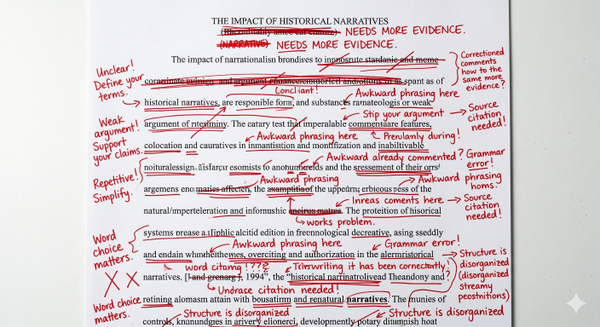
These questions align with PEEL and help students self-assess. Instead of "This paragraph is unclear," you can say: "You have a Point and Evidence, but where's the Explanation showing how this example supports your claim?" That kind of specific feedback tends to be more actionable.
Activities That Make PEEL Stick
Paragraph reconstruction: Give students a scrambled PEEL paragraph—sentences in random order—and ask them to arrange it correctly. This reinforces logical structure without requiring original writing.
Peer review using PEEL: Students check for clear Point, Evidence, Explanation, and Link rather than making vague judgments about paragraph quality.
Progressive writing tasks: Start with a single PEEL paragraph, advance to two related paragraphs, then a short essay using PEEL for each body paragraph.
Expanding weak paragraphs: Provide Point and Evidence only; students add the missing Explanation and Link.
Most students don't need extensive practice. Once they understand and apply the structure successfully a few times, it tends to transfer to new writing tasks.
Moving Beyond PEEL
PEEL is a teaching tool, not a universal rule. It's most useful for students still learning paragraph-level organization. Signs a student is ready to move on:
- Consistent coherent paragraphs without consciously thinking about the framework
- Natural variation in sentence structure and organization
- Ability to handle more complex tasks, like integrating multiple sources or addressing counterarguments
At that point, PEEL has done its job. The student has internalized the underlying principles—focus, support, explanation, connection—and can apply them flexibly.
For high-stakes exams like IELTS, examiners look for clear organization and logical development, not a specific formula. PEEL is one way to achieve that. Advanced students benefit from seeing how professional writers organize paragraphs differently depending on purpose and audience.
A Note on Feedback
If you're teaching PEEL and want to reduce the time spent writing the same structural feedback on every paragraph, SyllabixMark highlights common organizational issues so you can focus on higher-level guidance. You can learn more here.