How to Build a Writing Rubric That Teachers Can Actually Use Consistently
Even experienced teachers score the same essay differently on different days. In test-prep contexts like IELTS or OET, this undermines progress tracking and teacher confidence. The issue isn't competence—it's rubric design.

Why Writing Rubrics Fail in Practice
The gap between how a rubric reads and how it performs reveals fundamental design problems.
The Consistency Problem Nobody Talks About
Even experienced teachers score the same essay differently on different days. A paper marked as Band 6 on Tuesday morning might become Band 5.5 on Thursday afternoon—not because standards changed, but because the rubric allows too much interpretation.
This becomes more obvious with multiple teachers. Without calibration, two qualified teachers can easily disagree by a full band on identical work, both believing they're applying the criteria correctly.
In test-prep contexts like IELTS or OET, this undermines progress tracking and teacher confidence. The issue isn't competence—it's rubric design.
When Cognitive Load Destroys Consistency
Grading writing requires holding multiple elements in working memory: rubric descriptors, the current essay, and comparisons to previous work. When rubrics include too many criteria or abstract language, they exceed comfortable cognitive limits.
Teachers often default to general impressions rather than systematic application. They glance at the rubric, form an overall sense of quality, then find descriptors that fit. The rubric becomes decorative rather than functional.
Rubrics with seven or eight detailed criteria simply ask too much during grading.
Five Design Mistakes That Kill Consistency
1. Vague Descriptors That Sound Professional But Mean Nothing
Descriptors like "demonstrates adequate organization" or "uses appropriate vocabulary" appear everywhere. They sound authoritative but prove impossible to apply consistently.
"Adequate," "appropriate," and "effective" are judgment calls that different teachers interpret differently.
Compare these:
Vague: "Uses a range of vocabulary with some errors that do not impede communication."
Specific: "Uses common academic vocabulary accurately. May include 2–3 word choice errors per 250 words, but meaning remains clear."
The specific version gives teachers concrete features to identify.
2. Too Many Criteria
Comprehensive rubrics often include everything: thesis clarity, organization, paragraph structure, transitions, vocabulary range, vocabulary accuracy, grammar, punctuation, tone, and audience awareness.
Rubrics with more than four or five main criteria become difficult to use consistently. Teachers either spend excessive time per essay or mentally collapse criteria into holistic judgments.
Better design identifies priorities and combines related elements. Instead of separate "vocabulary range" and "vocabulary accuracy" criteria, use a single "Lexical Resource" criterion addressing both, similar to how IELTS structures its descriptors.
3. Overlapping Performance Bands
When performance levels aren't clearly differentiated, teachers struggle with adjacent bands.
Problematic:
- Band 3: "Some organizational structure present. Ideas may be unclear."
- Band 4: "Basic organizational structure. Ideas are generally clear."
The difference between "some" and "basic" structure isn't clear.
Clearer:
- Band 3: "Includes introduction and conclusion, but body paragraphs lack clear focus. Reader must work to follow main points."
- Band 4: "Each paragraph addresses one main idea. Reader can follow main points without difficulty."
4. Missing Anchor Examples
Abstract descriptors need concrete reference points. Without sample essays showing each performance level, teachers apply descriptors based on different mental models.
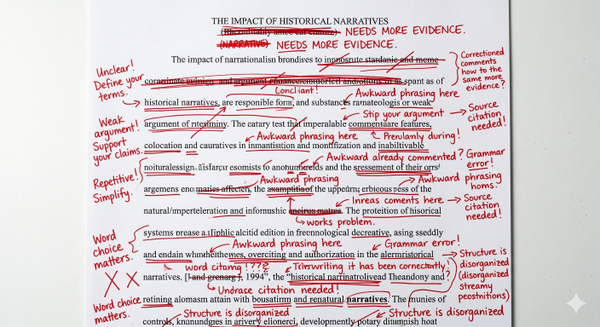
Effective samples include annotations showing specifically why they represent a particular level — not just the essay itself.
5. No Calibration Process
Well-designed rubrics drift over time without regular calibration. Teachers gradually shift standards unconsciously, especially in programs with independent work or staff turnover.
Building calibration into the assessment system — not treating it as optional — is what keeps a rubric functional over time.
Choosing the Right Rubric Type
Holistic vs. Analytic Rubrics
Holistic rubrics provide a single overall score. They're faster and appropriate when you need efficient scoring without detailed diagnostic feedback.
Analytic rubrics break writing into separate criteria, each scored independently. They take longer but provide specific information about where a student is strong or struggling.
For test-prep contexts, analytic rubrics generally work better because students benefit from understanding which areas need improvement. A student who scores well on Task Response but struggles with Grammatical Range needs different guidance than one with the opposite profile.
Single-Point Rubrics
Single-point rubrics describe only the target performance level, with space for teachers to note what exceeded or fell short. This reduces cognitive load — teachers compare work to one clear standard rather than choosing between several descriptive bands.
They work well for classroom contexts where feedback matters more than a precise numerical score. They're less suited to high-stakes testing or placement decisions.
Building Your Rubric: Step by Step
Step 1: Define What You're Measuring
Before writing descriptors, clarify which aspects of writing quality matter for your specific purpose. Many rubrics try to measure everything and end up measuring nothing clearly.
For IELTS Task 2, focus on the four official criteria: Task Response, Coherence and Cohesion, Lexical Resource, and Grammatical Range and Accuracy. For OET letters, the official criteria cover purpose, content, conciseness and clarity, genre and style, organization and layout, and language. For general academic writing, prioritize what actually matters for the task.
Step 2: Write Observable Descriptors
Describe what you would see in the text at each performance level. Use concrete features rather than evaluative adjectives.
Instead of "good use of linking devices," write: "Uses a variety of cohesive devices (however, furthermore, as a result) accurately. Referencing is clear throughout."
Instead of "limited grammatical control," write: "Simple sentences are generally accurate. Complex sentences contain frequent errors in subordination, verb forms, or article use. Errors sometimes obscure meaning."
Step 3: Create Clear Boundaries
Check whether the boundaries between adjacent levels are distinct. What would need to improve for a Band 5 to become a Band 6? If you can't articulate that clearly, the boundary needs work.
Look for overlapping language across levels. If multiple bands use phrases like "some errors" or "generally clear," you need more specificity about the type, frequency, or impact of those errors.
Step 4: Select and Annotate Sample Papers
Collect student essays representing each performance level. Annotate each one to show specifically why it sits at that level — highlight the features that match the descriptor. This makes abstract language concrete and gives teachers a reference point when they're uncertain.
Update your sample set periodically as you encounter clearer examples.
Maintaining Consistency Over Time
Running Calibration Sessions
Calibration doesn't need to be elaborate. A basic protocol:
- Select 2–3 papers representing different levels or near band boundaries
- Have each teacher score independently
- Compare scores and discuss discrepancies
- Focus on which rubric elements led to different interpretations
- Agree on appropriate scores; add strong examples to your anchor set
This takes 30–45 minutes and should happen regularly, monthly for programs with multiple teachers, or at the start of each term for individual teachers checking their own consistency.
Tracking Scoring Drift
Periodically re-score papers you've already marked, without looking at your previous scores. If you're consistently higher or lower than before, your standards have shifted.
For programs with multiple teachers, tracking average scores per teacher can surface drift. A significant difference between teachers may indicate a calibration issue — or simply different student populations.
When to Revise vs. Recalibrate
Not every consistency problem requires changing the rubric.
Consider revising when:
- Teachers consistently disagree on the same criterion across multiple sessions
- A descriptor is interpreted in fundamentally different ways despite the discussion
- The rubric doesn't capture an important aspect of performance
- Descriptors don't reflect the actual range of student work you're seeing
Consider recalibration (without revision) when:
- Teachers agree on what a descriptor means, but apply it at different thresholds
- Problems are recent and related to new staff or a long gap between sessions
- Most criteria work well, but one area needs realignment
Test-Prep Contexts
When preparing students for standardized tests, your rubric needs to align with official criteria — but official descriptors are often written at a level of abstraction that makes daily use inconsistent.
One practical approach is to create a more detailed internal rubric that unpacks official descriptors into observable features. For example, the IELTS Band 6 descriptor for Lexical Resource says "uses an adequate range of vocabulary for the task." Your internal version might specify: "uses topic-specific vocabulary beyond basic terms (e.g., for a technology topic: innovation, automation, implementation — not just computer, internet, technology)."
The key is to ensure your more detailed descriptors stay consistent with the official framework — not stricter or more lenient, just more specific.
The Role of Technology
Assessment tools can support consistency without replacing teacher judgment. Tools that provide reference databases of scored essays, flag potential scoring inconsistencies, or track scoring patterns over time can help teachers stay calibrated.
Current technology handles surface features reasonably well — sentence length, vocabulary diversity, error frequency — but struggles with argument quality, appropriate development of ideas, and contextual fit. It works best as a support layer, not a primary scoring mechanism.
Put This Into Practice
Building rubrics that teachers can use consistently means designing for human limitations rather than ideal conditions. That means accepting some loss of comprehensiveness in exchange for genuine usability.
The investment in clear descriptors, annotated examples, and regular calibration takes time. For programs where assessment quality matters — where students make decisions based on scores, or where multiple teachers need to work from shared standards — it's time that tends to pay off.
If you're teaching IELTS, OET, or other test-prep writing and want to see how consistent rubric application works with AI support, you can explore SyllabixMark. It's designed to help writing teachers maintain assessment consistency while keeping human judgment in control.
Learn more about SyllabixMark →