
What Teachers Should Correct First in an ESL Essay: Content, Organization, or Grammar?
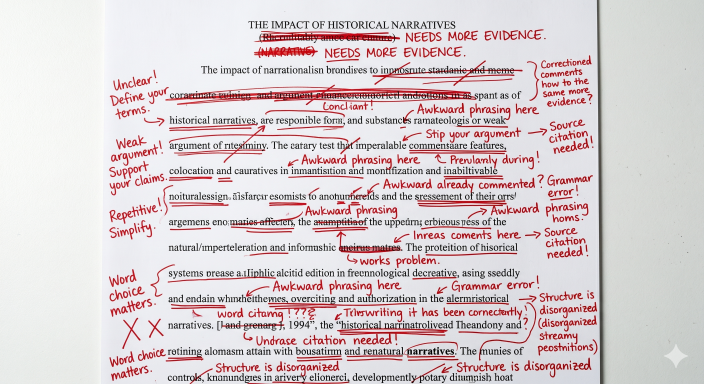
When an ESL essay has problems at every level, most teachers default to grammar. Research suggests that's usually the wrong place to start.

You're looking at an essay with a weak thesis, unclear paragraph structure, and grammar errors in nearly every sentence. You know the student needs help with all of it, but you also know that marking everything will produce a page covered in red ink and a student who doesn't know where to start.
So what do you correct first?
Content should usually come first, followed by organization, then grammar. This sequence aligns with second language writing research and helps students build from meaning to form rather than the reverse.
There's no universal answer that works for every essay or every student. But second language writing research and the accumulated experience of thousands of ESL teachers point to clear principles that can guide your decisions. This article walks through those principles and offers practical frameworks you can use starting with your next batch of essays.
The Traditional Grammar-First Approach vs. Current Understanding
For decades, the default approach in ESL writing instruction was to prioritise grammar. Teachers marked verb tenses, article errors, prepositions, and sentence boundaries before addressing anything else. The reasoning was straightforward: students need to write correctly before they can write well.
This approach made intuitive sense. Grammar errors are visible, countable, and easier to mark than vague or poorly developed ideas. Many teachers were trained this way, and many students expect it.
But contemporary research in second language writing has challenged this sequence. Studies on error correction effectiveness, cognitive load in revision, and the relationship between form and meaning suggest that grammar-first feedback often misses what matters most—and can actually slow down student progress.
One reason teachers still default to grammar is that it feels like the most objective layer to assess. A missing article is a missing article. But objectivity doesn't always equal priority, especially when the essay's central argument is unclear or its structure doesn't support the task.
What Second Language Writing Research Shows
Second language writing researchers have spent decades studying what kinds of feedback actually help students improve. A few findings are particularly relevant for correction priorities.
First, students have limited cognitive capacity for processing feedback. When they receive corrections on content, organisation, and grammar all at once, they often focus on the easiest fixes—usually surface-level grammar—while ignoring the more complex issues that would improve the essay more substantially.
Second, meaning-focused feedback tends to produce stronger revision than form-focused feedback, especially in early drafts. When students understand what they're trying to say and how to structure that message, grammatical accuracy often improves as a secondary effect.
Third, not all grammar errors are equally worth correcting. Research by Dana Ferris and others has shown that some error types are more "treatable" than others—meaning students can learn to self-correct them with targeted instruction. Other errors are more resistant to feedback and may require longer-term language development.
There's an ongoing debate in the field about whether grammar correction helps at all. John Truscott has argued that it's largely ineffective, while Dana Ferris and others have shown that selective, well-timed grammar feedback can support accuracy development. The current understanding among practitioners is that grammar feedback has a place, but timing and focus matter more than volume.
Why Content Should Usually Come First
Content is the foundation. If an essay doesn't answer the question, address the prompt, or develop a coherent argument, no amount of grammatical polish will make it effective.
In practice, this shows up most clearly when students misunderstand the task. An IELTS Task 2 essay that argues only one side of a discussion question, or an OET letter that omits key clinical information, has failed at the content level. Correcting grammar in those cases addresses a secondary problem while the primary one remains.
Content problems also tend to require the most substantive revision. If a student's thesis is unclear or their supporting points don't align with their argument, they'll need to rethink and rewrite significant portions of the essay. It makes little sense to correct sentence-level errors in paragraphs that may not survive the next draft.
When content is strong, the other layers become easier to address. A clear argument gives the essay structure. Structure makes grammatical issues more visible and easier to prioritise.
Identifying High-Priority Content Issues
Not every content gap requires immediate intervention. Some are more disruptive than others.
High-priority content issues include:
- Misunderstanding or not answering the prompt. The essay addresses a different question than the one asked.
- Missing or unclear thesis. The reader can't identify the main argument or position.
- Irrelevant or off-topic supporting points. The evidence or examples don't connect to the claim.
- Significant gaps in required information. In professional writing tasks like OET, this might mean missing clinical details or failing to include the necessary background.
Lower-priority content issues include:
- Underdeveloped examples that are otherwise relevant. The idea is there, but could be expanded.
- Minor tangents that don't derail the overall argument.
- Repetition of a point that's already been made clearly.
If the essay's core message is intact and the task has been understood, content may not be the first priority. But when content is fundamentally unclear or misaligned, it should be addressed before anything else.
When Organization Takes Priority
Organization becomes the primary focus when the content is generally sound, but the structure makes it hard to follow.
This often happens with intermediate to advanced ESL students who understand the task and have relevant ideas, but struggle to arrange those ideas logically. Paragraphs may lack clear topic sentences, transitions may be missing or ineffective, or the essay may present points in an order that confuses rather than clarifies.
Organisational problems affect readability more than isolated grammar errors do. A reader can usually parse a sentence with a missing article or an incorrect preposition. But if an essay's second paragraph introduces a counterargument without signalling it, or if supporting evidence appears before the claim it's meant to support, comprehension breaks down.
In these cases, feedback on structure—how to open a paragraph, how to sequence ideas, how to signal relationships between points—will do more to improve the essay than line-by-line grammar correction.
Recognising Organizational Issues by Proficiency Level
Organisational challenges look different depending on where a student is in their development.
Intermediate ESL students often struggle with:
- Paragraph unity. Multiple unrelated ideas appear in the same paragraph.
- Lack of topic sentences. Paragraphs begin with examples or evidence rather than claims.
- Weak or missing conclusions. The essay stops abruptly without summarising or closing the argument.
Advanced ESL students more commonly face:
- Ineffective transitions. Ideas are present and mostly ordered well, but the connections between them aren't explicit.
- Unclear emphasis. The most important points aren't foregrounded or highlighted structurally.
- Overly complex structure. The student attempts sophisticated organisation but loses clarity in the process.
A few diagnostic questions can help you decide if organisation should be your focus:
- Can you identify the main point of each paragraph within the first sentence or two?
- Does the order of paragraphs make logical sense, or could they be rearranged without loss?
- Are transitions between ideas clear, or does the essay feel like a list of disconnected points?
If the answer to any of these is no, organisation likely deserves priority over grammar.
When Grammar Should Take Priority
Grammar matters. It affects clarity, professionalism, and—in test contexts—scores. But it often works best as a later-stage focus, after content and organisation have been addressed.
One reason is efficiency. If a student is going to revise their thesis or reorganise their paragraphs, many of the sentences you might have corrected will be rewritten or deleted. Marking grammar in an early draft can mean correcting sentences that won't exist in the next version.
Another reason is cognitive load. When students receive grammar feedback alongside content and organisational feedback, they often prioritise the grammar because it feels more concrete and manageable. This can prevent them from engaging with the harder, more important work of clarifying their ideas.
That said, some grammar errors do interfere with meaning and should be addressed earlier. The key is distinguishing between errors that block comprehension and those that are merely noticeable.
Treatable vs. Untreatable Grammar Errors
Dana Ferris introduced a useful distinction between treatable and untreatable errors in ESL writing.
Treatable errors are rule-governed and can be corrected with explanation and practice. Examples include:
- Subject-verb agreement
- Verb tense consistency
- Article use (though this is more complex than it appears)
- Sentence boundaries (run-ons and fragments)
Untreatable errors are less predictable and often require deeper language acquisition. Examples include:
- Unidiomatic word choice
- Awkward phrasing that's technically correct but unclear
- Subtle preposition errors
- Register mismatches
If you're going to prioritise grammar feedback, focus on treatable errors that appear frequently and affect clarity. A student who consistently drops articles or shifts tenses unpredictably will benefit from targeted correction. A student whose phrasing is occasionally awkward but mostly clear may not need that feedback yet.
Three Practical Approaches to Feedback Sequencing
Here are three approaches you can use to sequence your feedback in a way that aligns with these principles.
1. Two-Stage Feedback Model
Provide content and organisation feedback first, ask the student to revise, then address grammar in the revised draft. This prevents wasted effort on sentences that won't survive revision and helps students focus on one layer at a time.
In practice, this might look like:
- Draft 1 feedback: Focus on thesis clarity, paragraph structure, task response, and logical flow.
- Draft 2 feedback: Address grammar patterns, sentence-level clarity, and surface errors.
This works well in classroom settings or tutoring contexts where multiple drafts are expected.
2. Single-Focus Approach
Choose a single priority for each round of feedback based on the essay's most significant weakness. This could be content, organisation, or grammar, but not all three at once.
For example:
- If the essay misses the prompt, focus entirely on task response and content relevance.
- If the content is strong but hard to follow, focus on paragraph structure and transitions.
- If the essay is clear and well-organised but contains frequent treatable errors, focus on grammar patterns.
This approach works well when you have limited time per essay or when students are easily overwhelmed.
3. Tiered Feedback Within a Single Draft
Mark the highest-priority issues directly and note lower-priority issues without detailed correction. For instance:
- Content/organisation: Provide explicit comments and suggestions.
- High-impact grammar: Mark patterns that affect clarity.
- Low-impact grammar: Note the presence of minor errors but don't correct each one individually.
This approach gives students a complete picture while still guiding their attention to what matters most.
Test Prep Contexts: IELTS and OET
High-stakes test contexts introduce an additional variable: scoring rubrics.
Both IELTS and OET assess writing across multiple dimensions, and those dimensions are not weighted equally in practice. Understanding how examiners tend to apply rubrics can help you prioritise feedback more strategically.
In IELTS Writing Task 2, the four criteria—Task Response, Coherence and Cohesion, Lexical Resource, and Grammatical Range and Accuracy—are equally weighted in theory. But in practice, an essay with a strong task response and clear organisation can score reasonably well even with noticeable grammar errors. An essay with perfect grammar but an unclear argument or weak structure will not.
In OET, the assessment criteria emphasise purpose, content, and clarity. Language accuracy matters, but primarily when errors interfere with meaning or professionalism. A letter that communicates clinical information clearly and appropriately will generally score higher than one with flawless grammar but missing key details.
This doesn't mean grammar is unimportant in test prep. But it does suggest that students aiming for a band 7 in IELTS or a B in OET often benefit more from feedback on structure and task response than from exhaustive grammar correction.
If your student is consistently scoring lower than expected despite relatively accurate grammar, the issue is likely content or organisation. If their ideas are clear and well-structured but grammar is holding them back, then grammar becomes the priority.
Building a Sustainable System
Principled feedback sequencing isn't just better for students—it's also more sustainable for teachers.
Marking everything in every essay is exhausting and often counterproductive. Students can't process that much feedback, and you can't maintain that level of detail across dozens of essays without burning out.
A more sustainable approach involves deciding in advance what you'll focus on for a given assignment or student. This might mean:
- Announcing a focus area before students submit (e.g., "This round, I'll be prioritising paragraph structure and transitions").
- Setting a feedback limit (e.g., "I'll mark the three most important issues in this draft").
- Using a rotating focus across assignments so that over time, all areas get attention without any single essay becoming overwhelming.
This kind of system requires letting go of the idea that good teaching means correcting everything. In practice, selective feedback often leads to better outcomes than comprehensive marking.
Try a Focused Feedback Approach
If you're looking for a way to implement these principles without adding to your workload, SyllabixMark can help. It's built to support teachers who want to give structured, prioritised feedback efficiently.
You can learn more here: SyllabixMark