Why Some IELTS Task 2 Essays Sound Good but Still Underperform
Many IELTS Task 2 essays sound fluent, well-structured, and confident, and still come back as Band 6. This guide breaks down where polished essays quietly lose points, and what to look for when diagnosing students who are stuck below Band 7.
Quick Answer: IELTS Task 2 essays that sound fluent but underperform typically fail in four areas: incomplete task response (mentioning vs. developing ideas), mechanical cohesion without logical progression, impressive vocabulary used inaccurately, and complex grammar attempted without control. The gap lies between what sounds good to students and what IELTS band descriptors actually measure.
You've probably seen it: a student submits an essay that reads smoothly, uses varied vocabulary, and avoids obvious grammar mistakes. The sentences flow. The structure looks organised. But the score comes back as Band 6 — sometimes a high 6, but still not the 7 they expected.
This disconnect is one of the more frustrating patterns in IELTS writing feedback. The essay sounds competent, but something in the scoring criteria isn't satisfied. The issue isn't usually a single glaring error. It's a gap between what creates the impression of fluency and what the IELTS band descriptors actually require.
Understanding this gap matters if you're teaching students stuck at Band 6 despite steady improvement in their English. The problem often isn't their language ability in general, it's how that ability aligns with the specific demands of IELTS Task 2 writing criteria.
Student Perception vs. IELTS Band Descriptors: The Core Disconnect
When students read their own essays, they notice fluency, tone, and whether the writing "sounds academic." If the essay uses linking words, avoids repetition, and includes some advanced vocabulary, it often feels complete to them.
IELTS examiners read against four distinct criteria:
- Task Achievement (or Task Response)
- Coherence and Cohesion
- Lexical Resource
- Grammatical Range and Accuracy
Each criterion has its own progression from Band 5 to Band 9, and an essay is assessed separately on all four. A student can perform well on surface-level fluency while underperforming on task logic, idea development, or lexical precision.
Students often conflate "sounding like an essay" with "answering the question fully." These are not the same thing. An essay can follow a five-paragraph structure, use formal register, and still fail to address all parts of the task or develop its main ideas beyond surface mention.
The gap starts here: students optimise for what they can hear, while examiners score what the band descriptors define.
Task Achievement vs. Fluency: When Ideas Are Mentioned, Not Developed
Task Achievement is where many polished essays lose points without the writer realising it.
A Band 7 essay should "address all parts of the task" and "present a clear position throughout the response." It should also "present, extend and support main ideas." A Band 6 essay "addresses all parts of the task although some parts may be more fully covered than others" and presents "relevant main ideas but some may be inadequately developed."
The difference often comes down to whether ideas are mentioned or developed.
Consider a task asking:
Some people believe that the best way to reduce crime is to give longer prison sentences. Others believe that there are better alternative ways to reduce crime. Discuss both views and give your opinion.
A Band 6 response might include:
On the one hand, longer prison sentences can reduce crime. When criminals are kept in prison for a long time, they cannot commit more crimes. This makes society safer. In addition, harsh punishments act as a deterrent.
This paragraph mentions two ideas: incapacitation and deterrence. But neither is extended or supported. There's no explanation of how deterrence works, when it might fail, or what kind of crime this applies to.
A Band 7 version might look like:
Supporters of longer sentences argue that incarceration prevents reoffending during the period of imprisonment. For violent offenders, this can offer immediate public protection. There is also the assumption that harsher penalties deter potential criminals, though this effect appears to depend on the certainty of being caught rather than sentence length alone.
The second version doesn't just state the idea — it qualifies it, adds nuance, and shows awareness of limitations. That's what "extend and support" means in practice.
Students often write fluently but thinly. The essay sounds complete because it's grammatically correct and well-linked, but the examiner sees a response that skims the surface of each point.
Mechanical Cohesion vs. Logical Coherence
Coherence and Cohesion is another criterion where surface fluency can be misleading.
Students are often taught to use cohesive devices — words like however, furthermore, in addition, and on the other hand. These can make an essay sound structured. But the IELTS rubric doesn't reward the presence of linking words. It rewards logical progression and clear relationships between ideas.
A common issue is mechanical cohesion: the essay uses connectors, but the ideas don't actually build on each other. Each paragraph introduces a new point without extending the previous one. The result is a list of observations rather than a developed argument.
For example:
Firstly, education is important for economic growth. Secondly, healthcare systems need more funding. Finally, governments should invest in infrastructure.
This structure is clear, but the three points are unrelated. The linking words create the appearance of logic, but there's no through-line.
Coherence also involves paragraphing that reflects idea grouping, not just formatting. A Band 7 essay uses paragraphs to organise related ideas, with each paragraph contributing to a larger line of reasoning. A Band 6 essay may have paragraphs that are correctly formatted but don't clearly distinguish one idea cluster from another.
Template-driven writing can reinforce this problem. If a student has memorised a structure like "introduction + two body paragraphs + conclusion," they may force their ideas into that shape regardless of whether it suits the task. The essay sounds organised, but the logic is shallow.
Lexical Resource: When Advanced Vocabulary Backfires
Lexical Resource is often misunderstood as "use difficult words." The Band 7 descriptor emphasises flexibility, precision, and awareness of collocation and connotation — not just range.
A Band 7 essay "uses a sufficient range of vocabulary to allow some flexibility and precision" and "uses less common lexical items with some awareness of style and collocation." A Band 6 essay "uses an adequate range of vocabulary for the task" and "attempts to use less common vocabulary but with some inaccuracy."
The key difference is control. A Band 6 writer may use impressive-sounding words, but often in ways that feel slightly off. Common patterns include:
- Memorised phrases used rigidly: "In this day and age," "plays a pivotal role," "cannot be denied that" — these can sound formal, but if they're dropped in without fitting the sentence logic, they feel mechanical.
- Collocation errors with advanced words: "make a crime" instead of "commit a crime," "take an advantage" instead of "take advantage," "highly expensive" instead of "very expensive."
- Synonym substitution without regard for connotation: replacing "children" with "juveniles" or "youngsters" in every sentence, or using "individuals" where "people" would be clearer.
Students who rely heavily on prepared vocabulary lists often produce essays that sound slightly unnatural — not wrong, exactly, but stiff. The examiner can tell the language is being deployed rather than used.
Impressive vocabulary only scores well if it's used accurately and naturally. Overreach often does more harm than simplicity with precision.
Grammatical Range and Accuracy: Complex vs. Controlled
A Band 7 essay "uses a variety of complex structures" and "produces frequent error-free sentences" while maintaining "good control of grammar and punctuation." A Band 6 essay "uses a mix of simple and complex sentence forms" and "makes some errors in grammar and punctuation but they rarely reduce communication."
The distinction isn't just about whether complex grammar appears — it's about whether it's controlled.
Many Band 6 essays include complex sentences, but with inconsistent accuracy. For example:
Although some people believe that technology is beneficial, but it also has negative effects.
This uses both a subordinating conjunction (although) and a coordinating conjunction (but) in the same sentence. The sentence looks complex, but the structure is incorrect.
Another pattern is overuse of relative clauses without full control:
People who they use smartphones often experience health problems.
The extra pronoun (they) is unnecessary and marks the sentence as uncontrolled.
Students are often coached to "use complex grammar" without being taught to check whether those structures are correct. The result is essays that sound ambitious but feel unstable.
The rubric rewards range and accuracy together. Attempting complexity without controlling it doesn't raise the score.
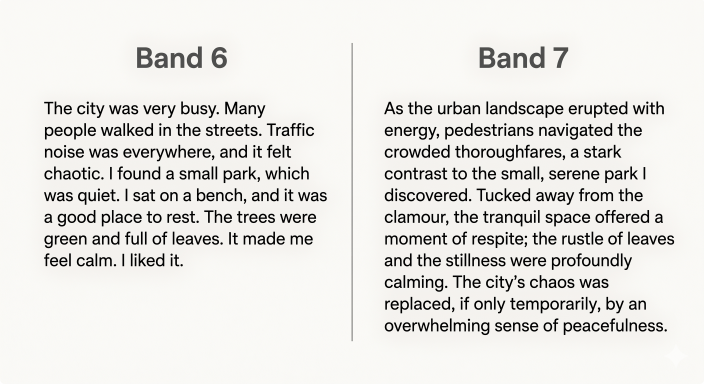
Diagnostic Checklist: Identifying Band 6 vs Band 7 Patterns
If you're teaching students who consistently write fluent essays but score Band 6, here are diagnostic checks:
Task Achievement:
- Does each body paragraph develop one clear idea, or does it list multiple points?
- Are examples and explanations present, or does the essay only make claims?
- Does the conclusion reflect the argument made, or just restate the introduction?
Coherence and Cohesion:
- Can you follow the logic without the linking words?
- Does each paragraph have a single focus, or does it shift between unrelated ideas?
- Are ideas developed across sentences, or does each sentence introduce something new?
Lexical Resource:
- Are advanced words used naturally, or do they feel inserted?
- Are there collocation errors with less common vocabulary?
- Does the essay paraphrase effectively, or does it repeat terms or use awkward synonyms?
Grammatical Range and Accuracy:
- Are complex sentences mostly correct, or are there recurring structural errors?
- Is punctuation accurate in longer sentences?
- Are errors scattered or patterned?
One pattern that shows up often is the essay that reads well on first pass but reveals gaps on closer reading. The fluency creates a halo effect — the teacher assumes the content is strong because the language sounds confident.
If you're looking for a way to surface these patterns more consistently, tools like SyllabixMark can help by flagging task response gaps, coherence issues, and lexical inaccuracies that are easy to miss in a quick read.
Get Clearer Essay Diagnostics
If you're spending time trying to explain why a fluent-sounding essay didn't score higher, you're not alone. The gap between surface polish and rubric performance is one of the harder things to teach — and assess consistently.
SyllabixMark evaluates essays against IELTS band descriptors and highlights specific areas where task response, coherence, lexical control, or grammatical accuracy may be underperforming.
Try it here: syllabixmark.ai