Why IELTS Students Keep Getting Band 6 in Writing: What Task Response Really Measures
Many IELTS students plateau at Band 6 in Writing not because of grammar, but because they only partly address the task, drift in their position, or underdevelop key ideas. Here is what Task Response is really measuring and how teachers can spot it faster.
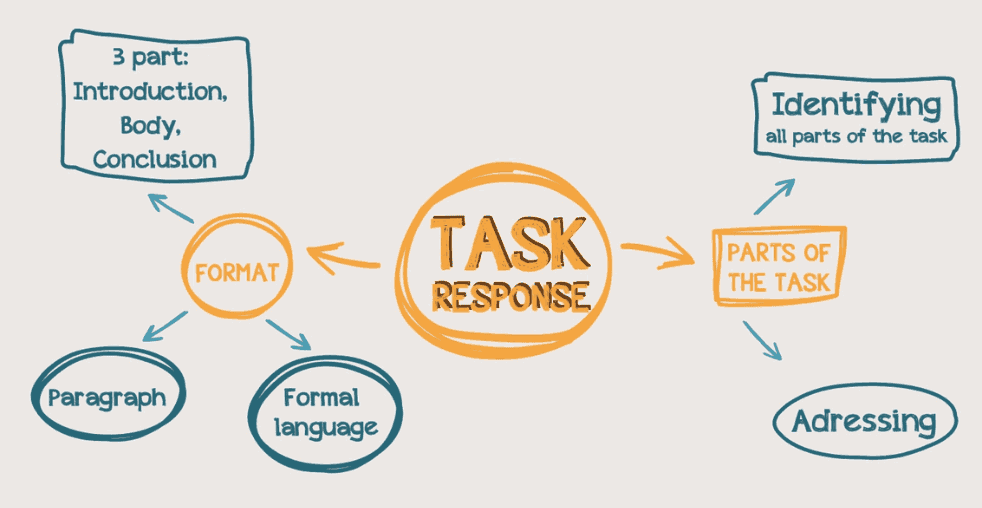
If your IELTS students keep landing on Band 6 in Writing despite decent grammar and solid vocabulary, the problem is often not language control. More often, it is Task Response: the part of the rubric that checks whether the essay actually answers the question clearly, fully, and consistently.
This is also why Task Response is one of the hardest criteria to teach. Grammar mistakes are visible. Vocabulary gaps are visible. Task Response problems are structural. They sit in the relationship between the prompt, the thesis, the body paragraphs, and the conclusion, which makes them easy for students to produce and easy for tired teachers to miss.
A Band 6 essay can look competent sentence by sentence and still fail to do what the task actually asked.
The public IELTS Writing Task 2 descriptors make this distinction clearer than many textbooks do. At Band 7, the response addresses all parts of the task, presents a clear position throughout, and extends and supports main ideas, even if some support lacks focus. At Band 6, the essay may address all parts, but some parts are more fully covered than others, conclusions may become unclear or repetitive, and main ideas may be insufficiently developed or less relevant.
That gap is where many otherwise capable students get stuck.
Why Band 6 essays look fine
Every teacher knows this student. The essay is grammatically functional. The vocabulary is good enough. Paragraphing is present. Linking phrases appear in the right places. Nothing looks obviously broken.
But Task Response is not asking whether the essay looks academic. It is asking whether the writer responded to this prompt, answered all parts of it, kept a clear position, and developed the ideas with relevant support.
That is why Band 6 essays often create a strange marking experience. You read them and think, “This seems fine,” but the score stays stubbornly low. The writing sounds like an essay, yet it does not fully complete the job the prompt assigned.
Three common TR problems
1. Uneven coverage
One of the most common Band 6 patterns is not total omission but uneven treatment. The student mentions every part of the task, but one side gets real development, while another part gets one sentence and a polite nod.
Take a prompt such as: “Discuss both views and give your own opinion.” A student may spend a full paragraph explaining why universities should prepare students for employment, then give only one general sentence to the idea that universities exist to pursue knowledge for its own sake. That technically touches both views, but it does not discuss both views with comparable substance, which is exactly the kind of imbalance the Band 6 descriptor allows for when “some parts may be more fully covered than others.”
A useful marking question is this: if you removed one side of the task, would the essay lose anything important? If the answer is no, the student probably mentioned that side without truly developing it.
2. Generic support
Another common issue is support that is relevant in a loose sense but too general to do much argumentative work. Students write sentences like “technology is important nowadays” or “students need practical skills for the modern world.” Those points are not wrong, but they often remain thin, predictable, and underdeveloped.
This matters because Band 7 expects main ideas to be presented, extended, and supported. A generic example may help the paragraph continue, but it does not always prove that the student has really engaged with the specific question.
In practice, this means many essays sound reasonable while still feeling vague. The student has a topic. They do not yet have an argument.
3. Position drift
This is one of the most damaging Task Response problems because it can hide inside otherwise fluent writing. A student opens with a clear opinion in the introduction, but the body paragraphs gradually soften, qualify, or contradict that position, and the conclusion ends somewhere slightly different from where the essay began.
The public descriptor for Band 7 is very clear here: the writer should present “a clear position throughout the response.” If the opinion is visible in the introduction but becomes blurred in paragraph three or diluted in the conclusion, the essay often falls back toward Band 6, where conclusions may become unclear or repetitive.
Teachers often describe this loosely as “weak development,” but the deeper issue is structural inconsistency. The thread of the argument does not hold from beginning to end.
What Task Response is really checking
Teachers often hear “address all parts of the task” and reduce it to a box-ticking exercise. In reality, Task Response is checking a small set of structural decisions that run through the whole essay.
Here are the four checks I would teach directly.
Prompt alignment
The first question is simple: Did the student answer the prompt type that was actually given? An agree/disagree question requires a position. A discuss-both-views question requires coverage of both sides plus an opinion. A problem-solution question requires both the problem and the solution to be addressed.
When students use memorized introductions, this is often where the trouble begins. If the opening could fit several different IELTS prompts, it is probably too generic to guide a strong Task Response.
Coverage
The next question is whether all the required parts are treated with enough substance. Coverage is not about equal word counts. It is about whether each required part receives meaningful development rather than a passing mention.
This is why some essays feel complete to the student and incomplete to the examiner. The student believes they answered everything because every keyword appeared somewhere. The rubric asks whether each part was actually addressed with relevant development.
Position consistency
A clear opinion is not a one-sentence event in the introduction. It has to remain stable across the body paragraphs and still be recognisable in the conclusion.
I often tell students to think of their opinion as the spine of the essay. If the spine bends too far in the middle, the whole response loses shape, even if each paragraph sounds reasonable on its own.
Development
Task Response is also checking whether ideas move beyond listing. Band 6 writing often gives a series of points. Band 7 writing usually explains them, extends them, and shows why they matter.
For example, “online learning is convenient” is only a starting point. A stronger version explains who benefits, under what conditions, and what limitation or consequence follows from that claim. Development is where the essay stops sounding prepared and starts sounding considered.
Why teachers miss these issues
This is the part more teachers should say out loud: Task Response is genuinely hard to mark consistently when you are tired, rushed, or working through a large batch of essays.
When marking grammar, your attention can stay local. You look at sentences. Task Response forces you to hold the prompt, the thesis, the paragraph function, the support, and the conclusion in your head at the same time. That is much harder to do after your twentieth essay on a Sunday night than after your second.
This is also why tutors sometimes over-score essays that “feel smart.” A student may use strong vocabulary and produce a polished tone, and the writing gives the impression of quality. But the descriptor is not rewarding polish alone. It is rewarding whether the task is fully addressed, the position is clear throughout, and the ideas are sufficiently developed and supported.
That is the real trap. Humans read for meaning and intention. The rubric reads for evidence on the page.
Many Band 6 essays are not bad essays. They are incomplete responses hidden inside competent English.
A better way to teach it
The most useful change most teachers can make is to stop giving vague feedback such as “develop more” or “add another example.” Those comments are not wrong, but they are often too abstract to produce better rewriting.
Instead, teach students to map the essay before they revise it:
- What exactly is the prompt asking me to do?
- What is my position in one sentence?
- Does each body paragraph clearly support that position or fulfil one required part of the task?
- Does the conclusion restate the same position rather than a softened version?
- Which paragraph is underdeveloped, generic, or only loosely connected to the thesis?
When students learn to check those questions, Task Response becomes much more visible. They stop thinking of the rubric as an examiner’s secret language and start seeing it as an argument structure they can control.
Where AI can help
This is also the point at which AI can be genuinely useful to teachers, not because it replaces judgment, but because it helps surface structural problems faster and more consistently.
A second-pass tool can help identify whether the essay matches the prompt type, whether one side of the task is clearly underdeveloped, whether the stated opinion drifts, and whether body paragraphs are adding ideas without really extending them. Those are exactly the kinds of issues that are easy to miss when you are marking manually at speed.
Used well, that kind of support does not replace teaching. It clears space for teaching. Instead of spending all your energy hunting for hidden inconsistencies, you can spend more of it explaining the problem, showing the student where the argument breaks, and coaching a meaningful revision.
Three questions to use today
If you want a fast classroom diagnostic, start with these three questions on your next set of essays:
- Does the conclusion clearly match the position in the introduction?
- Has every required part of the prompt been developed, not just mentioned?
- Does each body paragraph do a clear job in the argument, or is it simply adding another related idea?
Those three checks will catch a surprising amount of Band 6 Task Response weakness before you even get to grammar correction.
Task Response is not mysterious, but it is easy to under-teach because the problems are structural rather than grammatical. Many students stay at Band 6 not because their English is too weak, but because their essay only partly answers the task, drifts from its position, or fails to develop its main ideas clearly enough for the rubric.
If you want a faster way to spot prompt misalignment, underdeveloped coverage, and position drift before writing feedback, SyllabixMark is built for exactly that kind of second-pass review.