
Effective ESL Writing Feedback: How to Help Students Without Overwhelming Them

When you return a student's essay covered in red marks, you've often done more harm than good. The student sees dozens of corrections, feels discouraged, and doesn't know where to start. The writing doesn't improve much in the next draft, and you wonder why all that marking time didn't translate into progress.
The solution is selective feedback that reduces cognitive overload while maintaining effectiveness. This article covers practical strategies that ESL students can actually process and apply—without sacrificing your standards.
Why Comprehensive Correction Creates Overwhelm
Excessive correction triggers two problems: emotional shutdown and cognitive overload.
When students see their work heavily marked, many interpret it as judgment on their ability rather than guidance for improvement. This is especially true for adult learners and test-prep students who already feel pressure to perform. The emotional response—anxiety, frustration, or embarrassment—makes it harder for them to engage with the feedback rationally.
Even motivated students face a processing problem. Working memory has limits. If a student must address fifteen different error types across grammar, vocabulary, organization, and mechanics, they can't hold all that information in mind while revising. They may fix surface errors mechanically without internalizing the patterns, or focus on easy corrections while ignoring more important ones.
Students who receive heavy correction often produce shorter, simpler writing in subsequent assignments. They're trying to avoid errors rather than develop expression. This risk avoidance stalls progress.
The Case for Focused Correction
Second language writing research suggests that focused correction—targeting a limited set of error types—can be more effective than comprehensive marking.
When feedback addresses one or two specific structures, students can notice the pattern, understand the correction, and apply it in future writing. When feedback addresses everything at once, the learning opportunity is diluted.
Some studies have found that focused correction leads to greater accuracy gains over time, particularly for structures that students are developmentally ready to learn. This aligns with the concept of teachable moments—certain errors are more learnable at certain stages.
This doesn't mean ignoring other errors. It means being deliberate about priorities in any given round of feedback. You're not lowering standards; you're sequencing learning.
Three Practical Feedback Strategies
The Two-Plus-One Method
Choose two high-priority error types and one area of strength to highlight.
If a student consistently makes subject-verb agreement errors and struggles with article use, those become your focus areas for that assignment. Mark those errors clearly and lightly note others. Then identify one thing the student did well—perhaps improved paragraph structure or stronger topic sentences.
This works well for regular assignments where you can rotate focus areas over time. In one cycle, address grammar. In the next, shift to organization. Over the term, you've covered the range without overwhelming students.
Priority-Based Correction
Rank errors by their impact on clarity and proficiency expectations, then correct only the top tier.
Categories might include:
- High priority: Errors that obscure meaning or violate expectations for the student's level
- Medium priority: Noticeable errors that don't block comprehension
- Low priority: Minor issues that don't significantly affect readability
For an intermediate student, high-priority issues might include unclear pronoun reference, missing verbs, or serious word choice errors. Medium priority might be preposition mistakes. Low priority might be comma splices or slight awkwardness.
Focus marking energy on high-priority items and let the rest go for now.
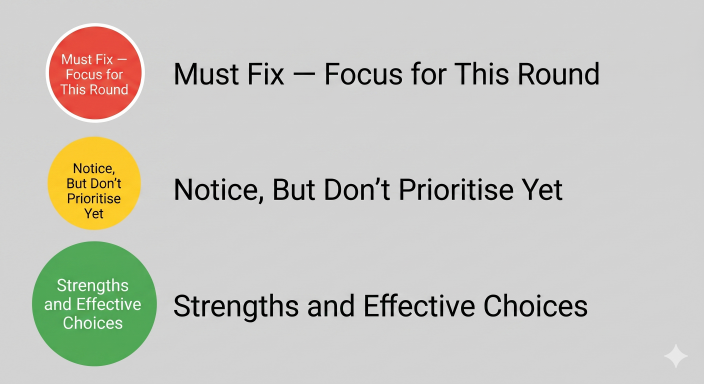
The Traffic Light System
Use color or symbol coding to show what requires immediate attention versus what can wait.
Mark errors in three tiers:
- Red: Must fix—focus for this round
- Yellow: Notice these, but don't prioritize yet
- Green: Strengths or effective choices
This gives students a visual hierarchy. They know where to direct revision effort without being paralyzed by undifferentiated marks.
Choosing What to Correct
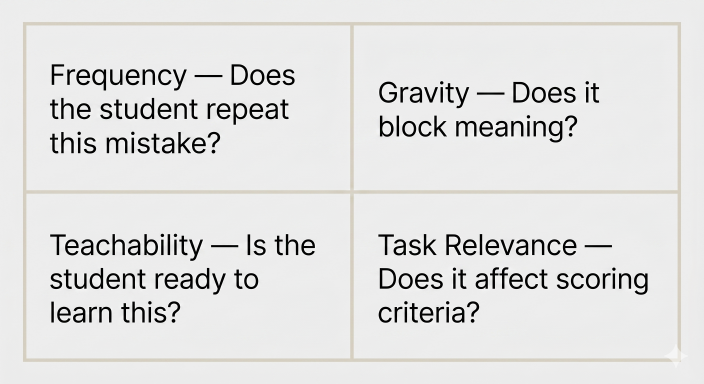
Several criteria can guide prioritization decisions.
Error frequency matters. If a student makes the same mistake repeatedly, addressing it will have a broad impact. A pattern of missing articles is more teachable than a one-off vocabulary slip.
Error gravity refers to how much the mistake affects meaning. A wrong preposition might be noticeable but not confusing. A missing subject makes the sentence hard to parse. Prioritize errors that interfere with communication.
Teachability considers whether the student is ready to learn the correction. Some structures are developmentally sequenced—learners acquire certain grammar in predictable stages. Correcting something they're not ready for often doesn't stick.
Task relevance also matters. In test-prep contexts, focus on error types that affect scoring criteria. For IELTS writing, that might mean prioritizing cohesion and task response over minor mechanical issues.
In practice, scan a piece of writing, identify two or three patterns that meet these criteria, and let other issues wait.
Delivering Usable Feedback
How you present feedback matters as much as what you choose to mark.
Timing affects retention. Feedback works best when it arrives while the task is fresh in the student's mind, ideally within a few days.
Marking codes versus explanations requires balance. Codes save time and work well for students who know the terminology. For lower-proficiency students or unfamiliar error types, brief explanations work better. "Plural subject needs plural verb" is clearer than "S/V" alone.
Written versus verbal feedback can be combined. Written comments provide a record. Verbal feedback adds nuance and allows questions. A short written summary plus a brief conversation often works better than pages of written comments alone.
Make feedback actionable. Instead of "awkward phrasing," try "consider reordering this sentence to put the main idea first." Instead of "unclear," try "who does 'they' refer to here?"
Managing Teacher Perfectionism
One challenge with selective feedback is the internal resistance teachers feel when leaving errors unmarked.
Many teachers believe comprehensive correction shows rigor and care. Letting errors go can feel like lowering standards. There's concern that students will internalize uncorrected errors as acceptable.
But leaving some errors unmarked in one round doesn't mean ignoring them forever. It means sequencing instruction based on what the student can realistically improve right now.
Reframe selective feedback as respect for the student's learning capacity. Overloading them doesn't demonstrate high standards; it shows inattention to how learning works.
If you're used to comprehensive marking, start small. Try the Two-Plus-One method on a single assignment and observe results. Many teachers find that students engage more thoughtfully with focused feedback.
Building Scalable Systems
Selective feedback saves time, but only with a system.
Set a timer. Decide in advance how much time you'll spend per essay—say, ten minutes. Use that constraint to enforce focus. Scan for patterns, mark top priorities, write a brief summary, and move on.
Batch similar tasks. If teaching multiple sections of the same level, create a priority list for each assignment in advance. This reduces decision fatigue and maintains consistency.
For ongoing classes, consider rotating focus areas on a schedule. Students know what to expect, and you're not reinventing your approach with each assignment.
Some teachers involve students in identifying their own priorities through brief self-assessments before submission. This makes feedback more relevant and increases student ownership.
Technology as Support
Technology can assist with pattern identification and routine error flagging, but it works best when supporting rather than replacing teacher judgment.
Grammar checkers can catch surface-level errors quickly, helping students clean up obvious mistakes before submission. This allows you to focus on higher-order issues like argumentation and coherence that tools handle poorly.
Some platforms help teachers manage selective feedback workflows by identifying recurring error patterns, making it easier to decide priorities without manually cataloging every mistake. The teacher still controls what gets emphasized and how feedback is framed.
Use technology where it genuinely reduces repetitive work while keeping interpretive and instructional decisions in your hands.
Try Focused Feedback in Practice
If you're looking for a way to manage selective feedback more efficiently across multiple students, SyllabixMark helps writing teachers identify patterns and streamline grading while keeping you in control of what matters.